New Challenges in Home Care – From Policy Trends to the Repositioning of Home Care Nurses
Update Date:2026/01/05,
Views:74
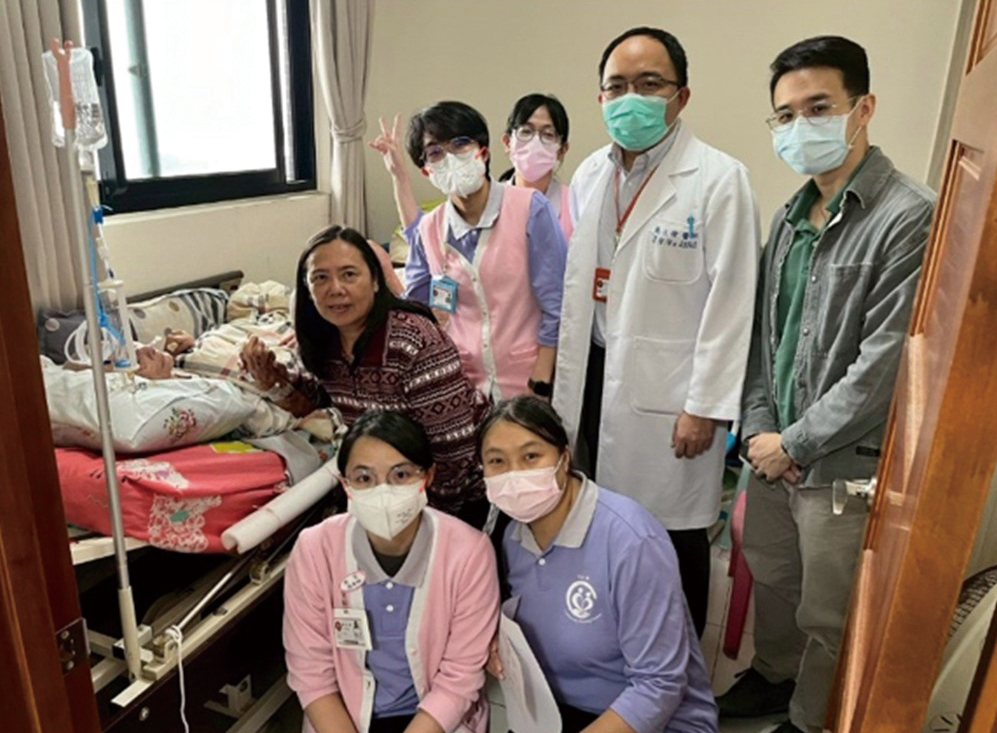
Nurse Chen Pin-Hui and the Home Care Team, Director Huang Pin-Hsuan
With the arrival of an ultra-aged society, the model of medical care is transforming. Elderly patients with multiple chronic diseases, disabilities, and rapidly increasing care needs, coupled with the pressures faced by medical institutions—such as limited hospital beds, overcrowded emergency departments, and a shortage of caregiving staff—are creating a tri-fold challenge. In an environment where "coexisting diseases in the elderly and increasing long-term care needs" are prevalent, the traditional hospital-centered care model is no longer able to fully meet the health and lifestyle needs of the elderly. Home care nurses have become key figures, bringing medical services into the community.
Home care nurses provide post-discharge care and home medical services for patients with disabilities. Their work primarily involves catheter care, wound care, and nursing guidance, focusing on lifestyle support and chronic disease management. The level of medical intervention is relatively limited, and most care is a passive continuation of hospital care. With the introduction of the Hospital at Home (HaH) program, the role of home care nurses has undergone a crucial transformation. They now bring "acute medical care" into the community, becoming an essential extension of the medical team at home. Home care nurses in the HaH model are required to have skills in acute symptom assessment, treatment monitoring, cross-disciplinary communication, and risk identification, assisting physicians in providing hospital-level care at home. They also play a key role in integrating the medical and caregiving systems, linking hospitals, communities, and long-term care resources.
1. Introduction to Hospital at Home (HaH)
The Ministry of Health and Welfare (MOHW) launched the Hospital at Home (HaH) program in July 2024. The goal is to extend acute medical care to the home environment, offering an alternative for suitable patients to receive medical treatment at home instead of being hospitalized. This program is designed to treat acute infections that would typically require short-term hospitalization, such as pneumonia, urinary tract infections, and soft tissue infections, allowing patients to receive necessary treatment at home and avoid the risk of hospital-acquired infections. It also reduces the burden on families caring for disabled patients. The healthcare team intervenes in the home to address acute issues, achieving the goal of reducing unnecessary hospitalizations, alleviating emergency department congestion, and improving healthcare resource efficiency. This creates a "home as the hospital" model of home care.
2. HaH Activation Process and Our Hospital’s Operational Model
In alignment with government policy, Tri-Service General Hospital will establish the Tri-Service General Hospital Home Acute Care Team in 2025. Urological infections will be the initial focus of our program, as home patients with long-term indwelling catheters are at high risk for urinary tract infections, which can cause unstable vital signs and rapid deterioration. This patient group has clear treatment and follow-up needs, making it suitable for the initial implementation of the HaH model. As the process matures, we hope to expand the program to treat other conditions such as pneumonia and soft tissue infections, providing more comprehensive support for the elderly through home acute care.
3. The Role and Importance of Home Care Nurses in HaH and Daily Care
Home care nurses have long been a vital link between hospitals and the community. Routine home visits are not only about performing nursing tasks but also about being the first line of defense for patient safety and early detection of medical changes. They play a key role in safeguarding the health of patients.
1. The Ones Who “See the Everyday”: Home care nurses are the most attuned to subtle changes in the patient's daily condition. When visiting a home, nurses observe not only vital signs but also the overall context of the patient’s life—decreased appetite, slower gait, changes in urine odor, and mental state. These seemingly small clues often reveal health changes earlier than clinical data. For elderly patients with reduced sensitivity or communication ability, the nurse’s visit may be the first to notice that "today is different," alerting the care team to potential issues.
2. Professional Window for the Family: When a patient experiences an acute infection or worsening condition, home care nurses actively compile and assess findings, discuss treatment options with physicians, and communicate clearly with the family about the patient’s condition, treatment plans, and care priorities. In long-term care households, the home care nurse is not only a caregiver but also a professional support pillar who stabilizes family emotions and builds trust.
3. Seamless Transition from Acute Care to Home Care: Through the HaH model, home care nurses administer antibiotics, monitor vital signs, track infection and treatment responses daily, and maintain real-time communication with the physician through telemedicine, playing a key role in ensuring the treatment progresses smoothly. Once acute symptoms are controlled, care naturally transitions back to routine home nursing, realizing a seamless connection between acute and chronic care, allowing patients to safely complete their treatment at home.
By reimagining the role of home care nurses within the Hospital at Home program, we can better address the increasing healthcare needs of the elderly and ensure that care is both continuous and comprehensive.