Next Steps for Kidney Patients: Renal Replacement Therapy and Choices
Update Date:2025/11/04,
Views:400
Dr. Xue Ru-Qian and Dr. Chen Xi-Zhi, Nephrology Division
As kidney function gradually worsens to end-stage renal disease (ESRD), the body can no longer eliminate toxins and excess fluids. At this point, alternative treatments such as "dialysis" or "kidney transplantation" need to be considered. The most common dialysis methods are hemodialysis (HD) and peritoneal dialysis (PD). Hemodialysis requires multiple visits to a dialysis center each week, while peritoneal dialysis can be done at home by changing dialysis fluid. Both methods help the patient eliminate metabolic waste outside the body.
According to the 2023 Taiwan Kidney Disease Annual Report, in 2021, there were 12,201 new dialysis patients in Taiwan, with an average dialysis age of 67.8 years. Among them, 11,027 patients (90.4%) used hemodialysis, and 1,174 patients (9.6%) used peritoneal dialysis. However, with the advancement of medical care concepts, more and more patients are seeking more flexible and higher-quality treatment methods. In such cases, "kidney transplantation" becomes the next step for patients to consider.
According to the Taiwan Kidney Disease Annual Report, the kidney transplantation waiting rate in Taiwan between 2012 and 2021 was 8.5% to 9.1%, meaning that nearly 9 out of every 100 prevalent dialysis patients were waiting for a kidney transplant. By 2021, the transplant rate was 3.9%, meaning that for every 100 patients on the waiting list, approximately 4 could receive a transplant. This indicates that Taiwan still has a significant opportunity to improve in promoting kidney transplantation and organ donation.
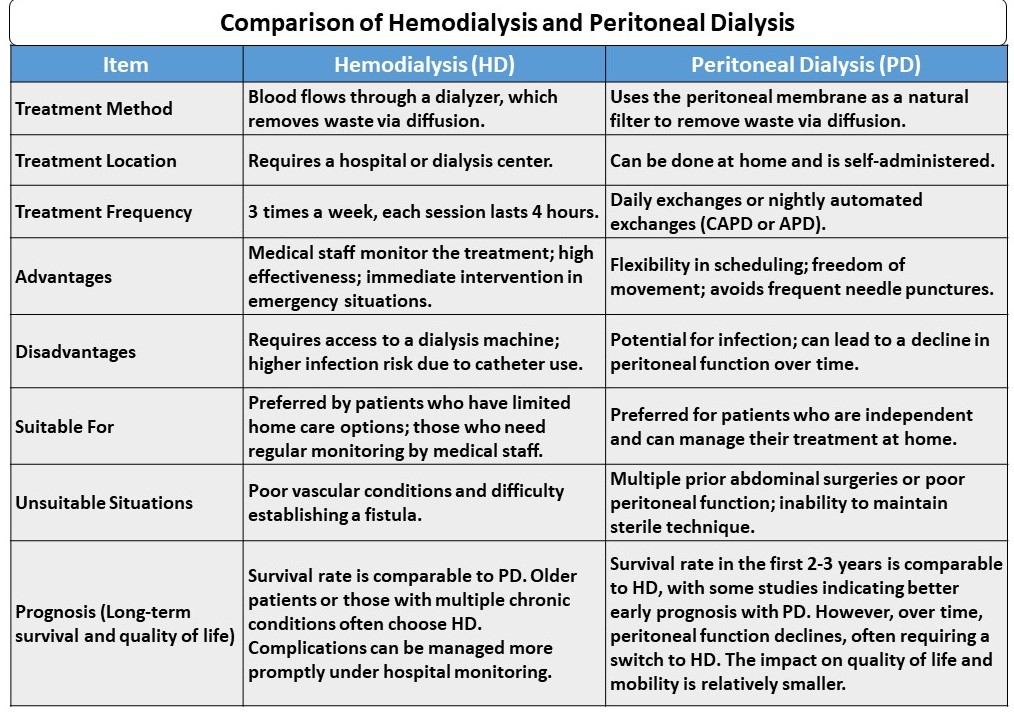
Comparison of Hemodialysis and Peritoneal Dialysis
The most common dialysis methods currently include hemodialysis and peritoneal dialysis. Here is a comparison table between the two:
When patients with uremia are faced with choosing between two types of dialysis, they often consider the following factors:
Factor Hemodialysis (HD) Peritoneal Dialysis (PD)
Lifestyle Wants to maintain freedom of movement, prefers home treatment → Peritoneal Dialysis. Used to hospital monitoring, needs medical assistance → Hemodialysis.
Physical Condition Poor vascular condition → Peritoneal Dialysis. Previous abdominal surgeries or poor peritoneal function → Hemodialysis.
Family Support Family available to assist and has high willingness to learn → Peritoneal Dialysis. Lack of support, insufficient self-care ability → Hemodialysis.
Long-term Prognosis Overall survival rate similar for both methods; choice depends on age, comorbidities, and lifestyle needs. Young, active patients, or those needing work or study → Peritoneal Dialysis maintains better quality of life.
• Elderly or those with multiple chronic diseases → Hemodialysis is safer under hospital monitoring.
Potential and Limitations of Home Hemodialysis
• Advantages: If successfully implemented, it allows patients to avoid frequent visits to dialysis centers, improving convenience and autonomy. It also improves blood flow rates and provides more flexible dialysis time, benefiting long-term health indicators.
• Challenges: High complexity in training and operation, requires well-maintained access and emergency response support. Historically, the high cost burden due to lack of insurance coverage was a challenge. With the inclusion of home dialysis in insurance coverage, there has been progress, but it still requires robust support from the healthcare system.
• Opportunities: Policy support and pilot programs are gradually being rolled out, favoring the introduction of innovative models (e.g., AI real-time monitoring, remote monitoring, supply chain support) into the market and clinical applications.
Current Status and Challenges of Peritoneal Dialysis (Home-Based)
• Advantages: Many PD patients already perform the procedure at home, and there is a solid foundation in terms of operational experience and system implementation. Taiwan has seen a decline in peritonitis rates in recent years, making it one of the safer countries in Asia for PD.
• Challenges: Despite the availability of technical and educational resources, the overall adoption rate remains low. This may be due to concerns about operational risks, infections, and physician preferences.
• Opportunities: The government has introduced plans to improve PD care quality and increase its popularity, aiming to reduce risks and improve feasibility and safety through medical information technology, remote monitoring, and educational support.
In Taiwan, most dialysis patients undergo hemodialysis, while only about 10% choose peritoneal dialysis. Although peritoneal dialysis has fewer users, studies have shown that its survival rate in the first few years is comparable to hemodialysis and in some cases even better. As a result, both the healthcare system and hospitals are encouraging more patients to consider peritoneal dialysis. As for home hemodialysis, it has been a relatively new option in Taiwan. Due to the lack of insurance coverage and the need for specialized training and emergency management skills, few patients opted for it in the past. However, starting in 2025, insurance has started to cover home hemodialysis, allowing patients to perform it at home with the support of a medical team and remote monitoring system, improving safety. In summary, most dialysis patients in Taiwan currently undergo hemodialysis at the hospital, while only a small number choose home-based peritoneal dialysis. Home hemodialysis is still in its early stages but is expected to increase gradually in the future.
Kidney Transplantation: The Hope of Restarting Life
Kidney transplantation involves transplanting a healthy kidney into a patient’s body, replacing the original failing kidney. Compared to patients undergoing hemodialysis or peritoneal dialysis, kidney transplant recipients can live with kidney function that is closest to normal, leading to higher survival rates. After a successful transplant, dialysis is no longer required. The sources of transplant kidneys are primarily living donor kidneys (often from relatives) and deceased donor kidneys (via organ allocation systems). Living donor transplants are increasingly valued in Taiwan due to shorter waiting times and higher matching success rates.
Advantages of Kidney Transplantation:
1. Patients can live with kidney function close to normal.
2. Fewer dietary and daily activity restrictions, significantly improving quality of life.
3. Long-term, the mortality rate and complication risks are lower compared to long-term dialysis, and the medical costs are more reasonable.
However, transplantation is not suitable for everyone and requires strict medical evaluation. After a successful transplant, patients must take immunosuppressants for life to prevent rejection and continue receiving follow-up care and infection risk management. Some patients may not be suitable for a transplant due to age, heart or lung function, or other health conditions, and will need to choose other forms of dialysis.
A Message to Kidney Patients: You Are Not Fighting Alone
Reaching end-stage kidney disease is undoubtedly a difficult journey. But it doesn’t mean life has to stop. Today’s medical options are no longer limited to a single dialysis choice. Whether you opt for home dialysis or pursue kidney transplantation, with proper preparation and cooperation in treatment, there is a chance to live a high-quality life every day. The medical team will work with you to think through and plan for the next step. Your body and life are still worth being cared for and embraced with hope.